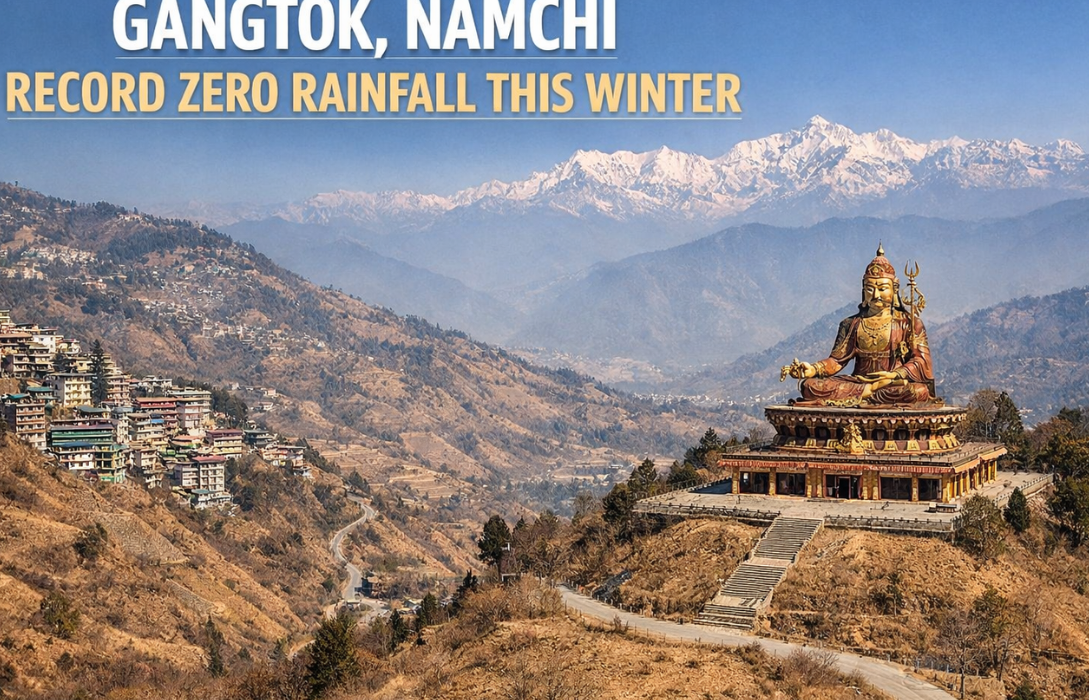
Sikkim is facing one of its most severe dry winter spells in nearly a decade, with Gangtok and Namchi districts receiving no rainfall for more than two consecutive months. The unusually dry conditions have triggered concerns among meteorological experts and local authorities.
According to the India Meteorological Department (IMD), Gangtok, both Gangtok and Namchi recorded a 100% rainfall deficit during December 2025 and January 2026, with dry conditions continuing into early February.
IMD Data Shows Severe Rainfall Deficiency Across Sikkim
District-Wise Rainfall Deficit Overview
IMD’s cumulative rainfall data from January 1 to February 2, 2026, reveals alarming trends across the State:
-
Gangtok and Namchi: 0 mm rainfall (100% deficit)
-
Mangan and Soreng: 97% deficit
-
Gyalshing: 99% deficit
-
Pakyong: 55% deficit, slightly better but still significantly below normal
Meteorological records show that Gangtok last received measurable rainfall on November 23, 2025, making the current dry spell unusually long for the Sikkim Himalayan region.
Absence of Western Disturbances Behind Dry Conditions
Key Weather Systems Remain Inactive
Officials from the Gangtok Meteorological Centre stated that such prolonged winter dryness occurs once in about ten years. The primary reason is the lack of active Western Disturbances, which are essential for winter rain and snowfall in Sikkim.
Currently, these weather systems remain confined to the north-western Himalayan region, positioned at higher latitudes and altitudes, with insufficient moisture to influence eastern Himalayan states.
What Are Western Disturbances?
Why They Matter for Winter Rainfall
Western Disturbances (WDs) are extratropical cyclonic systems that originate over the Mediterranean, Caspian, and Black Seas. Moving eastward with the westerly jet stream, they bring crucial winter rain and snow to north and northwest India, including the Himalayan belt, between December and March.
Their current inactivity has directly contributed to the rainfall deficit in Sikkim.
Lack of Bay of Bengal Activity Adds to Moisture Shortage
Meteorological officials also pointed to the absence of cyclonic systems in the Bay of Bengal, which usually help channel moisture toward the eastern Himalayan region during winter months. This has further intensified the dry spell across the State.
Rising Risk of Forest Fires and Water Shortages
Environmental and Agricultural Concerns Grow
The extended dry conditions have increased the risk of forest and bush fires across Sikkim. Dried ground vegetation has become highly flammable, raising safety concerns, especially in forested and rural areas.
There are also growing worries about the rapid depletion of natural springs, which could affect drinking water supply and agricultural activities, particularly in remote villages.
In previous years, similar dry spells led to frequent forest fire incidents, prompting authorities to install forest fire watch camps in vulnerable zones. Officials say that continued dry weather may require similar precautionary measures in the coming weeks.